


I want to tell you about a moment most people have lived through at least once.
You’re three years into a relationship that stopped feeling right somewhere around year two. Or you’re two years into a degree you no longer want. Or six months into a side project that every signal is telling you to drop. And every time you think about walking away, one thought stops you cold: but I’ve already put so much into this.
That thought has a name. Psychologists call it the sunk cost fallacy, and once you understand it, you start seeing it everywhere; in your own choices and in almost everyone around you.
What’s Actually Happening in Your Head
A sunk cost is anything you’ve already spent that you can’t get back : time, money, effort, emotional energy. It’s gone no matter what you decide next. The fallacy is letting that unrecoverable past dictate a decision that should only be about the future.
Logically, this makes no sense. The rational move is to ask “given where I am right now, is this still the best path forward?” and ignore everything already spent. But almost nobody’s brain works that way, mine included.
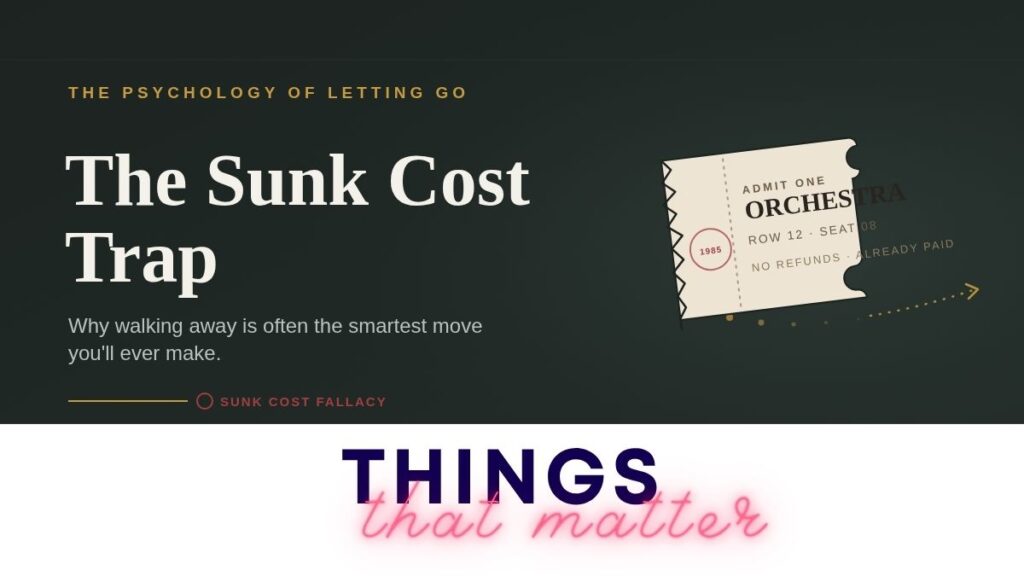
The classic proof of this comes from a 1985 study by psychologists Hal Arkes and Catherine Blumer. They gave people theater tickets, some at full price, some discounted, for the same show. The people who paid full price showed up more. Same performance, same night, same experience waiting for them. The only difference was how much they’d already sunk into the ticket, and that alone changed their behavior.
What convinces me this isn’t just a “modern brain” problem is a more recent finding out of the University of Minnesota. Researchers ran a similar test on mice and rats — waiting for a reward instead of a ski trip — and found the same pattern. The longer an animal had already waited, the less likely it was to give up, even when giving up was clearly the better move. If rodents do this too, we’re not dealing with a quirky cultural habit. We’re dealing with something wired into how brains weigh effort against reward.
Where This Actually Shows Up
Not in some abstract “market study” but in the actual decisions we make on a random Tuesday:
Staying in a relationship because of the years already built together, not because of how it feels now. Finishing a business degree you dread because of the tuition already paid. Keeping a failing side hustle alive because of the weekends already sacrificed for it. Forcing your way through a boring book because you’re “already halfway.” Holding a losing stock instead of cutting your losses, because selling would mean admitting the first decision was wrong.
Every one of these has the same quiet narrator running in the background: if I stop now, everything I already gave was for nothing.
Why It’s Not Just Annoying but Actually Bad for You & Me
This isn’t only a productivity problem. There’s a real mental health cost to staying somewhere your gut has already left.
A study surveying over a thousand adults found something worth sitting with: people who fell into sunk-cost thinking reported more symptoms of depression and disordered eating — and they waited longer to ask for help when things got hard. Getting stuck in a bad decision and getting stuck in silence seem to travel together.
There’s also an age pattern here that I find genuinely humbling. Research comparing younger and older adults found that older people are less likely to fall for the sunk cost fallacy than younger ones. Which means the exact life stage a lot of us are in right now like building a career, a relationship, a sense of who we are, all is also the stage where this trap has the strongest grip.
Why This Generation Gets Hit Especially Hard
Every generation deals with sunk costs. But a few things make this decade rougher.
We’re drowning in options in a way no generation before us has been. Barry Schwartz’s “paradox of choice” idea — that too many choices create anxiety instead of freedom isn’t just a theory anymore, it’s showing up in surveys. One 2024 study found the majority of Gen Z respondents feel genuine anxiety just deciding what to order off a menu. If picking food creates that much friction, imagine picking a career.
The mental health data backs this up too. Recent surveys show a large share of Gen Z rating their own well-being as only fair or poor, with anxiety described as a near-constant state for a big chunk of the generation notably worse than older generations report for themselves. Mental health now ranks as one of the top concerns for young people globally, just behind cost of living.
And the sunk costs themselves are bigger than they used to be. Student debt. A job market being reshaped by AI in real time. Surveys of recent graduates show a lot of them are already second-guessing the career they picked, worried it’ll be irrelevant in a few years. That’s a heavier thing to walk away from than a bad theater ticket.
Add in a culture where everyone’s wins are on display and quitting anything can feel like a public confession of failure, and you get a generation set up almost perfectly to stay stuck longer than it needs to.
What Actually Helps
I’m not going to pretend there’s a magic fix, but a few things genuinely help cut through this:
Ask yourself, honestly: am I choosing this because of where it’s going, or because of what I’ve already put in? Then try the zero-based test if you had zero history with this decision, would you choose it today, knowing what you know now? If the answer is no, that’s information you can’t unhear.
It also helps to remember that whatever you’ve already spent is gone either way. Staying doesn’t get it back. The only real choice in front of you is what happens from here, and what you could build instead with that same time and energy.
Deciding in advance what would make you walk away, before your emotions are the ones driving, takes a surprising amount of pressure off. So does asking someone outside the situation what they’d do, or just imagining what you’d tell a friend in your exact spot. It’s always easier to see clearly from the outside.
And honestly, practicing on the small stuff matters more than people think. Stop the bad movie halfway through. Cancel the subscription you never use. Every small “quit,” done for the right reasons, makes the big ones a little less terrifying.
The Part That Actually Changed How I Think About This
The sunk cost fallacy tries to convince you that walking away erases the value of what you already gave. It’s the opposite. Recognizing when to stop is what protects that investment — by refusing to spend even more of it on something that’s already stopped serving you.
Nothing you’ve already put in is wasted. It taught you something. It’s the reason you know, now, what you actually want. What is wasted is continuing to pay for a future that doesn’t fit who you’re becoming anymore.
Everything around us is built to reward doubling down. But sometimes the most rational, most self-respecting thing you can do is stop, take stock, and choose again.
This is something I think about a lot, and writing it out helped me untangle it. If it hit home for you too, I’d love to hear where you’ve noticed this in your own life.


